Showing posts with label models. Show all posts

Feb 6, 2012

More of my Father's Work

My father passed away last week and we had a memorial service on February 3rd at the UU Church of Lancaster in Lancaster , PA.  While I was home for the service I got some pictures of some of my Dad's creative work that I haven't photographed or posted previously.  The first set are all of a miniature scale model church my dad made for me and gave me on my 16th birthday.  I had felt called to the ministry from a young age and so he made me a church which even had my name printed on the wayside pulpit as the minister.  The entire model stands slightly over a foot tall.


Miniature church by Donald L. Roberts, for his son Ralph Yeager Roberts

Miniature church by Donald L. Roberts,
for his son Ralph Yeager Roberts


Miniature church by Donald L. Roberts,
 for his son Ralph Yeager Roberts

Miniature church by Donald L. Roberts,
for his son Ralph Yeager Roberts

Miniature church by Donald L. Roberts,
for his son Ralph Yeager Roberts


Miniature church by Donald L. Roberts,
for his son Ralph Yeager Roberts

Miniature church by Donald L. Roberts,
for his son Ralph Yeager Roberts

Miniature church by Donald L. Roberts,
for his son Ralph Yeager Roberts

Miniature church by Donald L. Roberts, for his son Ralph Yeager Roberts

Miniature church by Donald L. Roberts,
for his son Ralph Yeager Roberts

Miniature church by Donald L. Roberts,
for his son Ralph Yeager Roberts

Miniature church by Donald L. Roberts, for his son Ralph Yeager Roberts

Miniature church by Donald L. Roberts,
for his son Ralph Yeager Roberts

Following the pictures of the scale model miniature church are a selection of Dad's paintings and illustrations.  The water colors are done on paper in a dry brush style.  The one of my sister Donna's Cottage in Mount Gretna Pennsylvania was one he did only a couple years ago.  He was having difficulty controlling his brush for the past ten years or so which prevented him from continuing to work in oils which had always been his primary medium.  He was frustrated with watercolors in recent years and mostly restricted his artistic attempts to did pen and ink illustrations.  This makes the painting of the cottage special since he wasn't even doing water colors anymore but made an exception for this piece.  Ironically it is in my opinion his best water color.
The oil painting of the woman posing with a leg on a stool is in oils and was done before I was born.  It is on canvas paper.  The portrait in pencil is of my mother Joan Y. Roberts.  The other watercolor is from a photo taken of my mother during a trip she and Dad took to the Bahamas in the late 70s.
By Donald L. Roberts


By Donald L. Roberts


By Donald L. Roberts

By Donald L. Roberts
Finally I have included photos of some miniature buildings dad made.  The are scale models showing the facade of three buildings in Lancaster PA.  One is of Wheatland the historic home of President James Buchanan.  In the other picture you can see his models of the Fulton Opera House and the house at 334 Coral St. which my parents owned and rented as apartments (my sister Patty used to live there) but when I was in 6th grade they moved into the building combining the two units as a single residence.  Unfortunately he didn't include the other structure on the same plot as the Coral street house.  The other building was a single story building that originally had a bakery and in the basement was a barber shop.  This building they made a small apartment which my brother Kevin lived in for years including the time when mom and dad and I lived on coral Street. (that could have been explained with greater clarity, do forgive the quick and unrefined verbiage)
By Donald L. Roberts

By Donald L. Roberts

Jul 21, 2011

Some Nativity Scene Furnishings from 2010 in Detail


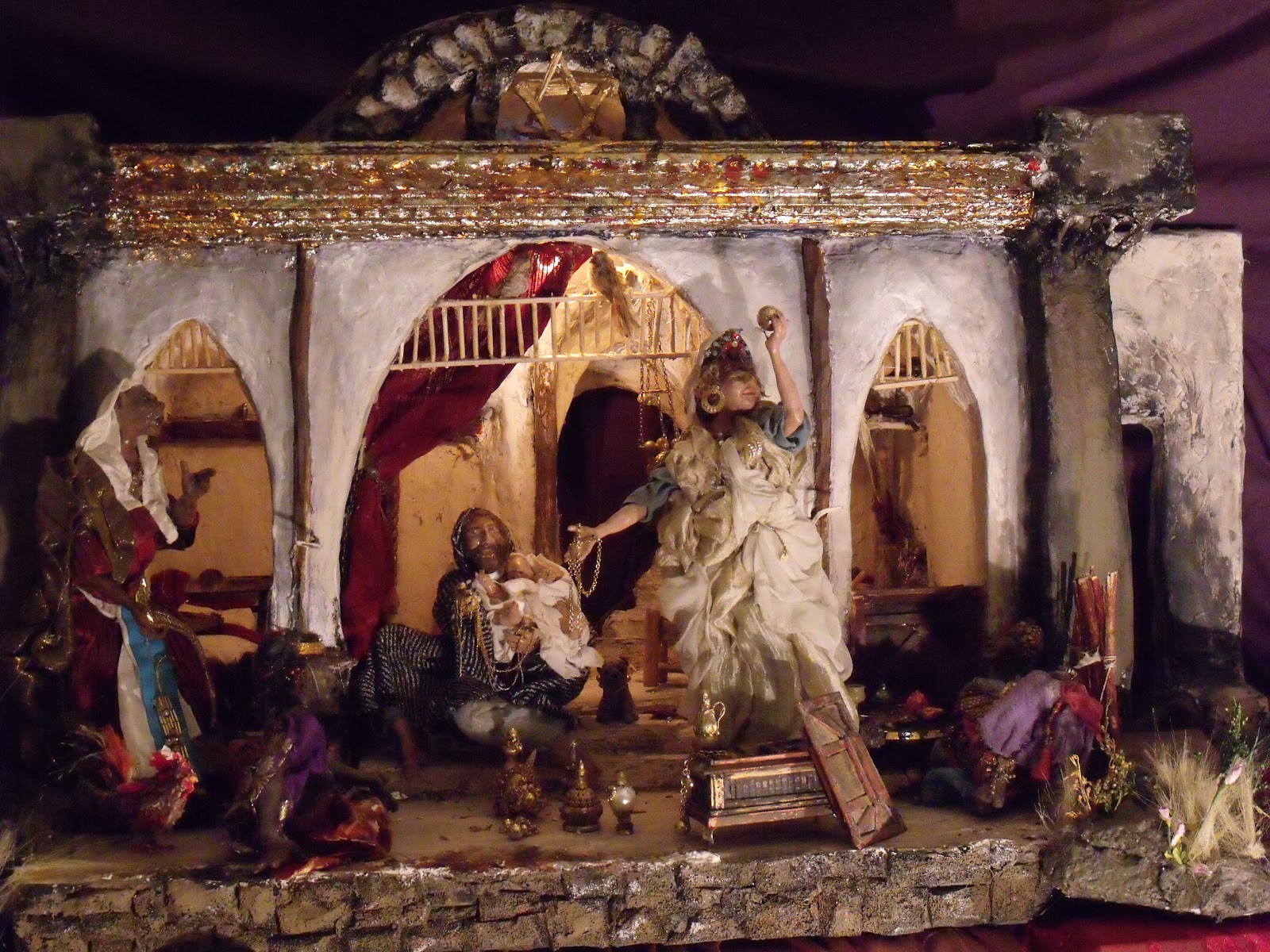
Original Nativity Scene by Ralph Yeager Roberts 2010,
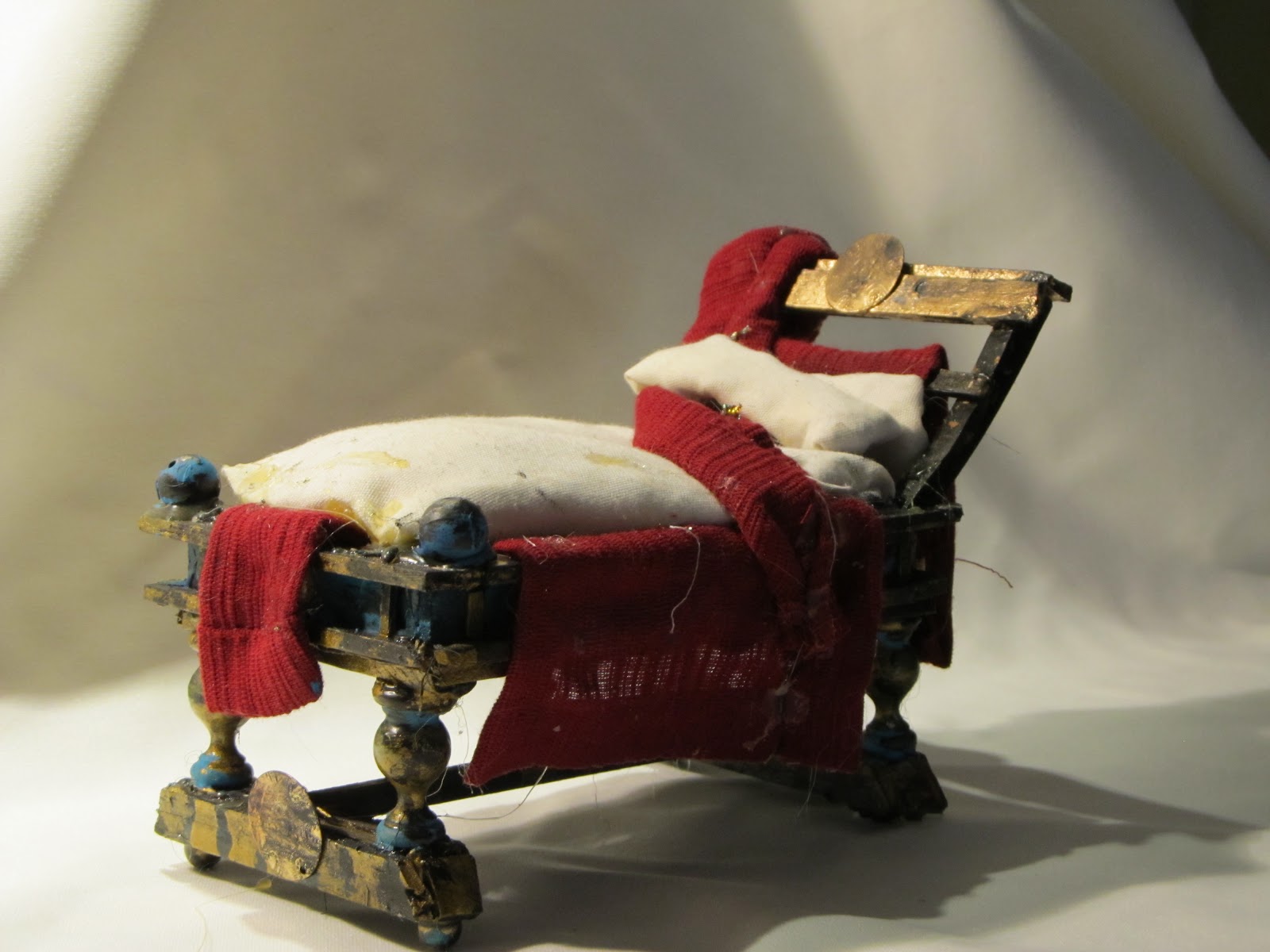
Roman Style Couch

I wanted to include some detail photos of some of the furnishings which do not show up clearly on the images posted previously of my 2010 Nativity Scene depicting the adoration of the Magi.  In My version Jesus, Mary and Joseph are clearly in a one and have some distinct Hellenistic affectations.  One example of this is in the room that serves as sitting area, library and master bedroom the couch or bed is styled like roman beds or dining couches.

In my initial plans for this Manger - less Christmas decoration, the magi and Joseph where going to be shown reclining at the end of their meal.  However even in including this couch and many of the other furnishings I found it unwieldy to have the furniture scaled to match the people.  The entire scene would be even larger than it turned out which is roughly 4' X 2.5' X 2.5 ' in fact it measures wider at the base when an additional porch section is included in the measurements.  To have the detail I sought and impose some limits to the project the room dimensions and furniture are scaled somewhat smaller and are seen behind the figures creating a sense of space and distance while submitting to the limitations I felt needed for the final project.


Original Nativity Scene
by Ralph Yeager Roberts 2010,
 Roman Style Couch


Original Nativity Scene By Ralph Yeager Roberts, 2010
Tables with food
 

Original Nativity Scene By Ralph Yeager Roberts, 2010
Tables with food

Though I did not stick to my roman banquet plan I do still have the Manger set showing the wise men and Holy family just following a meal that has been served to the travelers.  The signs of this which I include are sprinkled here and there.  In the photo you will see a marble stool able to double as a side table and a round wooden table both of which show the signs of the meal that has just been enjoyed.  Clearly I will have to try some of the miniature food tutorials that people have posted here and there.  My food is hardly convincingly realistic but there is a suggestion of some sort of pottage or stew and I tried to create pomegranates and goblets of wine.  The forks spoons and knives are simply doll house accessories  I found  and Incorporated.


Original Nativity Scene By Ralph Yeager Roberts, 2010
Tables with food
 
Original Nativity Scene By Ralph Yeager Roberts, 2010
Tables with food


You may be able to identify these various furnishings in a photo of the whole scene but you have to look rather closely.

Original Nativity Scene by Ralph Yeager Roberts, 2010
Between Mary and the figure reclining and a bit obscured to the far right
you an see the round black lacquered table

Original Nativity Scene by Ralph Yeager Roberts, 2010
Looking through the left most archway below the bend in the arm of the king with the whit head covering you can see the top bar of the backrest to the couch and below that some of the linens and pillows on the couch.

May 3, 2011

Original Nativity Scene for 2011 is Under Way

I have had so many ideas following my Nativity scene unveiled this past December and plan to create some other scenes around some of these further reflections and inspiration.  I have sculpted arms, legs, and heads, as well as some animals and everyday tools and vessels.  Much of this was done in anticipation of a scene of the shepherds coming to pay homage to the child as recorded in Luke.  It would be a sensible follow up on last years visit of the Magi.  However I think it will be a less familiar story that is wrapped up in the stories of Jesus birth.  The scene I am intending will be a bit gaudy yet modest in that it will include merely two figures.  The scene will be that of Zachariah in the Temple when the angel Gabriel appears to him and announces that Elizabeth, Long Barren, will have a child.  Making a model of the Temple interior will be fun but it is what I intend for Gabriel that I am most excited about.  I will update as things proceed.  I have been gluing feathers onto a base for wings and they are looking pretty amazing.

Jan 15, 2011

Miniature Ancient Library (from my original Nativity Scene


Library Miniature by Ralph Yeager Roberts 2010


 My favorite element in the Nativity Scene I recently completed is easy to miss.  In my effort to stay close to the Biblical narrative the manger and stable are replaced with a stylized representation of an ancient Palestinian home.  The home I seek to show is neither squalid nor opulent and is meant to present this family as somewhere closer to the economic middle in society at the time than we have tended to suppose of the fairly in which Jesus was raised.  The library is found in the home along the back wall near the little window opening.  It is one of the hidden delights available when a viewer pours over the piece a bit.  That viewer will see built into the wall this classically designed built in storage piece loaded with papers and scrolls.


 Pride in the quality of the miniature book case and its contents is largely why it is my favorite single element in the whole scene.  The cabinetry is made entirely out of wood except the circular molding embellishments which are plastic disks which came from some beads I had.  For the scrolls I simply rolled strips of paper.  Some of the scrolls are meant to have the wood rods with tooled caps on either end as would be used to unroll and maintain ones place while reading a given volume.  For these I used a combination of beads and wooden pieces, hats and heads, in fact, popped off of the figures in a broken German nativity scene.  I just enjoy the fact that my scrolls look realistic thanks to the little decapitated shepherds and wise men from a discarded ornament.  If you look at the pictures you will also see that I have included little bottles of ink, a cup of styluses and quills, some cloth for blotting wet sections, and loose papers.

Library Miniature by Ralph Yeager Roberts 2010


Beyond the quality of the final piece it is also one I like because it touches on the role of writing and literacy in the world at this time and among the Jews.  While there has been some difficulty determining the literacy of Palestine at this time.  Not only are we uncertain just how many people could read but what they could read and of that what they could understand is hard to know.  Hebrew would have been used but many believe it was largely ceremonial as today with Hebrew in American synagogue or Latin in the catholic church.  It is likely that at least boys would have been able to read but not understand Hebrew.  Though there are a significant number of Aramaic retelling of the scriptures which suggest that in the synagogue they would often rely on the vernacular of the people.  But could the average person read these Aramaic texts.  Alexander the great starts a campaign that did rocket literacy rates but how much.  Furthermore Greek seems to have been the international language as was french in the 1700's.


There is much that could be said but in including the bookshelf I was seeking to weigh in on the side of a broad number of people being literate.  At the very least I am suggesting that Jesus would have been literate and as his teachings suggest more than mere literacy but a familiarity with not just the scriptures but the teachings and debates engaged by figures such as Hillel and Philo not to mention the suggestions of his ideas having ties to works and writings from the pagan world.  With this kind of education I am imagining that the family is already one that values and uses written documents in their work and leisure.  While it is a modest sized collection by today's standards if we think of the costly nature of any manuscript and of paper itself then this small collection of literature and official documentation and practical notes and records would represent a significant investment.

Miniature household items for Nativity Scene
 by Ralph Yeager Roberts 2010


Beyond the library I included a few other items which where meant to suggest that the family could read and write and did so in their daily lives.  In the detail picture of some household items I included in the finished Nativity Scene there is a portable laptop or tabletop writing desk and a reusable writing tablet common to this period.  The tablet had wax surfaces that you could write notes on by scratching the wax and then melt the wax and smooth it out once you no longer needed the notes and have a clean surface for the next time you needed to write something down.

Jan 10, 2011

Mager Making Family


Ceramic Nativity Set, Grace Yeager c. 1960

Making my own Nativity Scene was in part inspired by the work of my father and my maternal grandmother.  Two of the Nativity scenes that decorated my childhood home where original one of a kind manger scenes. 


Ceramic Nativity Set, Grace Yeager c. 1960
 My Grandmother painted and glazed ceramic figurines and at my mother's request made her a Nativity Scene.  The figures are each about a foot tall.  In making this set my grandmother chose to paint the people using a dark honey brown color for their skin.  While the look is a bit extreme and looks odd on Mary and the angel whose yellow blond hair with such a choice of flesh tone makes them apear like they over did it at the tanning bed.  However her tip of the hat to a non anglo european origin for this story is effective juxtoposed with the posture and dress of the figures which is clearly modeled on images produced durring the italian rennesance.
While Grammy produced her Scene some years before I was even born I have vivid memories of my Father working on his diorama of the birth of Jesus.  He started out making figures out of plastic army men, whittling off their guns and weapon packs then draping them in glue soaked scraps of cloth.  In fact there is a king with an orange headdress who started out as a Darth Vader knock off from a "Star Battles" bag of plastic soldiers someone bought me as a present.  Later he made the people by bending a wire armature and then covering it with latex caulking, like the stuff in the tube used to close seams around the tub.  The army men demanded accommodation, fitting the scene to the limited range of poses available.  By contrast there was a freedom to present something closely fitting his artistic vision with the new silicon and wire people looked to suffer some serious skin condition.

My Dad wanted to show a scene that was more urban than normally pictured and which located the family and visitors off center and small relative to the overall image.  He also wanted the stable to look like one and modeled the mangers pictured after ones originally used for horses in a barn on our own property which he used as an art studio.  The overall theme you could say was to show the humanity, and humbleness of things as well as the hidden nature or anonymity in which the child is delivered.

Diorama Nativity Scene, Donald L. Roberts c. 1980


As with my own project both my Grammy and Dad set out to invite the viewer to encounter the familiar story with a heightened attention to some historical detail which is often obscured by stylized and sentimental images.  Certainly there is much to be questioned and dismissed in both pieces as far as achieving historical accuracy.  The Magi enter the scene some months after the child is born, there is no word of angels, Bethlehem would have been only slightly more cosmopolitan than Nazareth a town of maybe 50 adults, It never says that they where in a stable only that the child was laid in a manger, the inn was probably a reference to a guest room of sorts on the family property, and of course there is no reason to think this more than temporary housing after all the Magi are said to arrive at a house.  Yet it is not historic accuracy in the actual scenes they produced nor in my own that I think is the goal. 
At  least for my own part I would say the hope of crafting a true to life image of these moments of religious history is unrealistic and fr ought with problems.  However in our own telling of the stories over the years different generations recreate the vital and fleshy truth of the tales in how they depict the story as a mix of the familiar and to that age- every day aspects of life and in how they show in the nativity scene something foreign and other. 

Diorama Nativity Scene, Donald L. Roberts c. 1980

After all it is meant to be something more profound than the historic equivalent of a candid Polaroid image.  I think even artists who wish to shock us with the banal humanity of it all are unable to do so without showing both the grit and flesh of the matter and the ultimate truth that is there the heavenly story if you will.  Angels are used to do this but so too my father's historically tenuous stable scene which reveals a truth of the story which is humility and meekness. 
For my part I wanted to saturate the scene with elements that suggested a context which could explain in almost ordinary terms a child who might grow up and do as Jesus did, a mother who had drive and purpose, resources to allow for an education of some depth, a family located less at the social margins and able to broker the connections as we see in Jesus circle of well off and influential hosts and followers, and so forth.  It is a bit grand in aim granted but it is a grand story and when seen in person it is a rather grand final piece.
Original Nativity Scene by Ralph Yeager Roberts, 2008-2011